Start with the licence
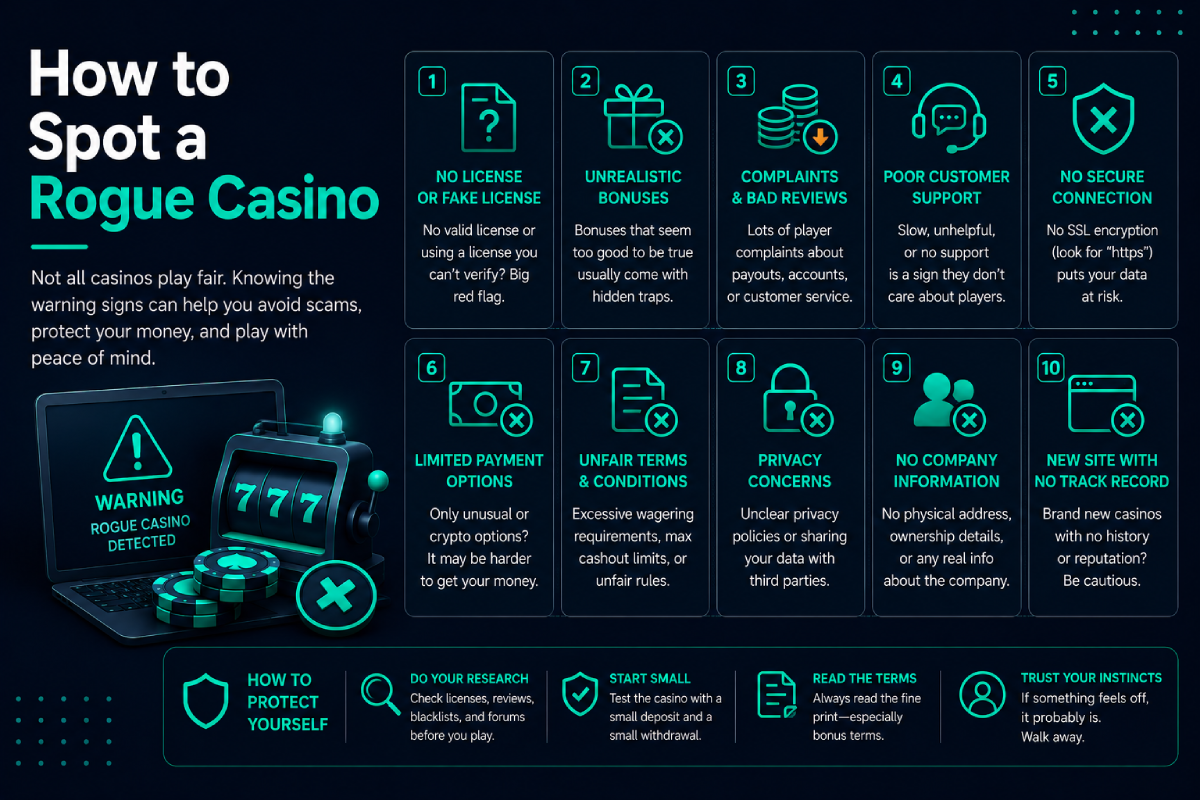
The single most useful thing you can do before depositing anywhere is to check the licence, and then actually verify it. Almost every casino displays a regulator's name and a licence number in the footer, often as a clickable seal. A rogue operator counts on you seeing that badge and stopping there. Do not stop there. A logo is just an image, and images can be copied, faked or linked to a licence that expired years ago.
Verifying takes two minutes. Note the regulator named in the footer, then go directly to that regulator's own website by typing its address yourself rather than clicking the casino's link. Every serious authority keeps a public register you can search, whether that is the UK Gambling Commission, the Malta Gaming Authority or another. Look up the casino by name or licence number and confirm three things: that the licence exists, that it is currently active rather than lapsed or revoked, and that the company name and domain on the register match the site you are on. A mismatch here, where the licence belongs to a different brand or an unfamiliar domain, is one of the clearest signs of a rogue casino there is.
Read the withdrawal terms first
Depositing is always easy. Getting your money back out is where rogue casinos reveal themselves, so read the withdrawal section of the terms before you fund an account, not after you have won. Skim past the marketing and find the specifics that decide whether a payout ever reaches you.
Look for the withdrawal limits: a daily, weekly or monthly cap that is suspiciously low is a classic tactic for drip-feeding a big win back to you so slowly that you give up or gamble it away. A site that lets you deposit thousands in one click but only pays out a few hundred a week is telling you something. Check the minimum withdrawal, any cash-out fees, and whether the casino can hold funds in a lengthy "pending" state it can reverse. Confirm the KYC rules too: being asked to verify your identity is normal, but a site that only springs an impossible document list on you the moment you try to withdraw is using verification as a stalling weapon. If the withdrawal terms are vague, contradictory or missing entirely, walk away.
Bonus terms that scream trouble
A generous headline bonus is the bait rogue casinos use most often, because the real conditions live in the fine print almost nobody reads. A good bonus has terms you can understand in a single pass. A trap has terms designed so you can never realistically clear them.
The number to find first is the wagering requirement. A fair offer sits around 30 to 40 times the bonus; anything reaching into 60x, 70x or higher is engineered to keep your money. Then check whether wagering applies to the bonus alone or to your deposit plus the bonus, because the latter quietly multiplies what you must bet. Watch for a maximum cashout cap that limits how much of a bonus win you can withdraw, tight max-bet rules that void everything if you slip over them by a cent, and short expiry windows that make completion impossible by design. Game weighting matters too: if only a handful of high-edge slots count fully toward wagering, the offer is worth far less than it looks. When bonus terms feel deliberately confusing, that is usually the point.
Support you can actually reach
You will only ever really need customer support when something has gone wrong, which is exactly when a rogue casino wants to be hardest to reach. Test support before you deposit, not during a dispute. It is the cheapest insurance you can buy.
Open the live chat and ask a genuine question, such as how long a card withdrawal takes or what documents KYC will require. A trustworthy operator answers promptly, clearly and in a language you can follow. A real business usually offers live chat plus a monitored email address, so be wary of a site whose only channel is a contact form that vanishes into silence. Slow, evasive, copy-paste replies, or an agent who cannot answer a basic payout question, all tell you how a genuine dispute would go. A physical company address and a named licensing company in the footer are further reassurance; their absence is a quiet red flag.
Reputation signals & red flags
No casino has a perfect record, so a scattering of complaints is normal and not proof of anything. What you are looking for is a pattern, especially players describing the same problem: winnings confiscated, verification used to stall payouts, or accounts closed the moment someone gets ahead. Search the casino's name alongside phrases like "withdrawal problem" or "not paying", read independent reviews and player forums, and weigh the substance of complaints rather than the star rating. The table below sums up the signals we weigh most heavily.
| Green flag | Red flag |
|---|---|
| Licence verified as active on the regulator's own register | Licence badge that is unclickable, expired or names a different brand |
| Clear withdrawal limits, fees and timeframes stated up front | Very low payout caps or vague, contradictory cash-out rules |
| Reasonable wagering (around 30-40x) in plain language | Sky-high wagering, hidden max-cashout caps and confusing terms |
| Fast, clear live chat plus a monitored email address | Support that is slow, evasive or reachable only by web form |
| Mostly resolved complaints and a traceable operating company | Repeated "won't pay" reports and no company address anywhere |
| Visible responsible-gambling tools and deposit limits | Pressure to deposit more, with no self-exclusion options |
If a casino won't pay
If you have done everything right and a casino still refuses to pay, stay calm and methodical, because a paper trail is your strongest asset. Start by putting the dispute in writing to the casino's support team and keep copies of everything, including screenshots of your balance, the withdrawal request, the bonus terms and every message exchanged. Ask plainly which specific term they are relying on to withhold your money, and give them a reasonable window to respond.
If that goes nowhere, escalate along the routes built for exactly this situation. Complain to the regulator whose licence you verified earlier, since a licensed operator can be compelled to answer to its authority, and many regulators run a formal player-complaint process. Take the case to an independent alternative dispute resolution (ADR) service, a neutral third party that arbitrates between players and licensed casinos free of charge and which reputable operators are usually required to join. If you funded the account by card and the operator was clearly in breach, you may be able to ask your bank about a chargeback, though this route can be slow and is not guaranteed. Throughout, protect yourself first: never chase a loss with a bigger deposit, and if the stress is mounting, step back and use the tools on our responsible gambling page.
FAQ
What is a rogue casino?
A rogue casino is an online gambling site that treats players unfairly, typically by refusing to pay legitimate winnings, hiding predatory terms in the fine print, or operating without a genuine, verifiable licence. They often look polished and professional, which is exactly why checking the licence and withdrawal terms before you deposit matters so much.
How do I verify a casino's licence?
Note the regulator named in the site's footer, then go directly to that regulator's own website by typing the address yourself. Search its public register for the casino by name or licence number, and confirm the licence is active and that the company name and domain match the site you are on. A logo alone proves nothing.
What wagering requirement is too high?
A fair welcome bonus usually carries wagering of around 30 to 40 times the bonus amount. Once you see 60x, 70x or higher, or terms that apply wagering to your deposit plus the bonus, the offer is likely designed so you can never realistically clear it. Always read whether max-bet limits and cashout caps apply too.
What can I do if a casino refuses to pay me?
Keep a written record of everything, then complain to the casino in writing and ask which exact term it is relying on. If that fails, escalate to the regulator that issued its licence, take the case to an independent ADR service, and, if you paid by card, ask your bank about a chargeback. Never deposit more to try to win the money back.