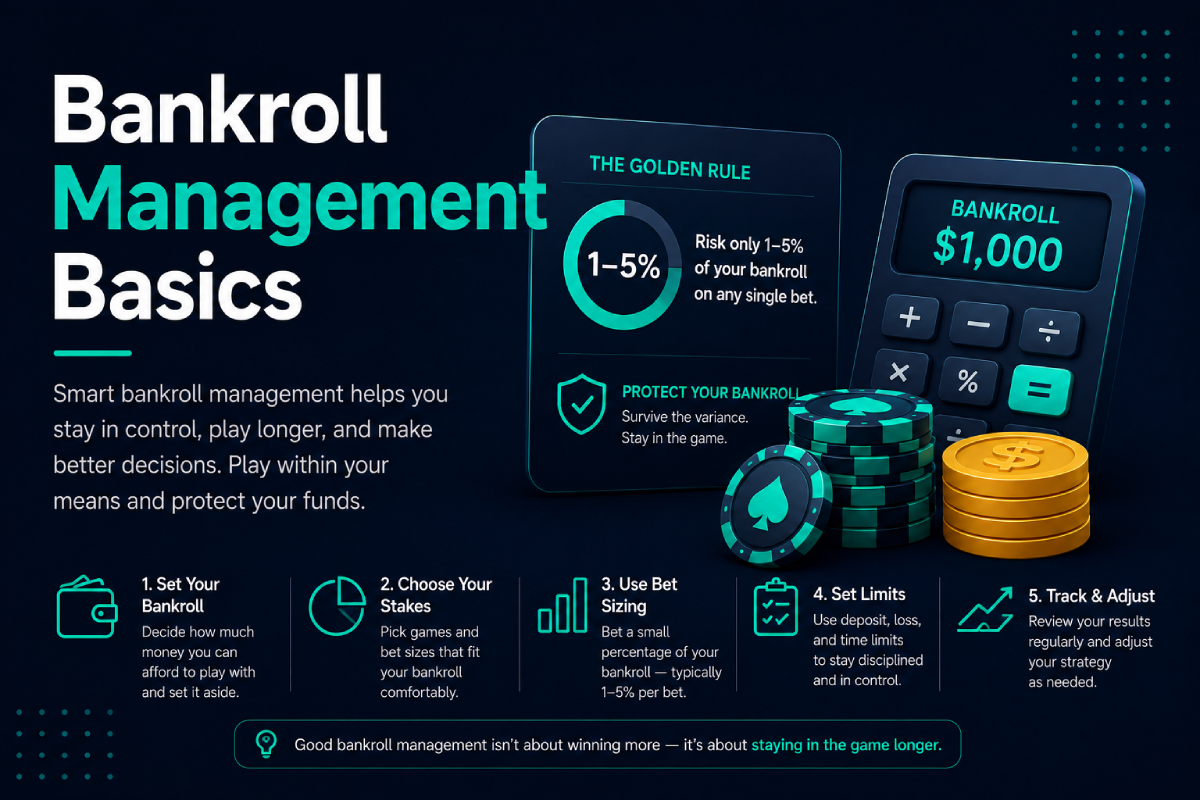
What a bankroll actually is
A bankroll is simply the pot of money you have set aside for gambling and nothing else. It is not your rent, not your grocery budget, and not money you are hoping to turn into more money. The defining test is blunt: if losing all of it would change how you pay a bill, sleep at night, or feel about yourself next week, it is too much. A bankroll should be money you have already mentally spent on entertainment, in the same way you would budget for a night out or a streaming subscription.
Thinking of it this way changes every decision that follows. Once the money is ring-fenced as entertainment, you stop measuring a session by whether you finished ahead and start measuring it by whether you stayed inside your plan. That shift is the whole point of bankroll management. The house edge guarantees that, over enough spins, the maths favours the casino. What you can control is how much you expose, how fast you spend it, and when you walk away.
Set a session budget (never a chase budget)
Your bankroll is the total; a session budget is the slice you allow yourself for one sitting. Splitting a monthly bankroll into several smaller session budgets is one of the simplest habits you can build, because it stops a single bad evening from swallowing everything at once. If you have set aside $200 for the month, four $50 sessions will almost always be more fun, and last far longer, than one uncapped blowout.
The critical rule is that a session budget is a spending limit, not a target. A chase budget is the opposite and the trap: it is money you go looking for after a loss, telling yourself one more deposit will win it back. It almost never does, and the top-up you promised was your last quietly becomes the next one. Decide your session figure before you log in, deposit exactly that amount, and treat the moment it is gone as the natural end of the session. If you want to model how long a given budget might realistically last at your chosen stake, our bankroll session calculator does the arithmetic for you.
Bet-sizing rules of thumb
Once you know your session budget, bet sizing decides how much play you get from it. The common-sense guideline is to keep each bet a small fraction of the session amount, roughly one to two percent, so that a normal run of losing spins cannot wipe you out in a handful of clicks. Bet too large relative to your budget and variance ends the session in minutes; bet sensibly and the same money can stretch across a long, enjoyable stretch of play.
The table below shows the idea in practice. The spin counts assume no wins along the way, so they are a deliberately pessimistic floor rather than a promise; in a real session, wins will extend your time considerably.
| Session bankroll | Suggested bet range | Approx. spins (no wins) |
|---|---|---|
| $50 | $0.50 - $1.00 | 50 - 100 |
| $100 | $1.00 - $2.00 | 50 - 100 |
| $250 | $2.50 - $5.00 | 50 - 100 |
| $500 | $5.00 - $10.00 | 50 - 100 |
| $1,000 | $10.00 - $20.00 | 50 - 100 |
Notice that the spin count stays roughly constant while the stakes scale with the budget. That is the point: bet sizing is always relative to the money in front of you, never an absolute figure. A $10 spin is reckless on a $50 budget and perfectly reasonable on a $1,000 one.
Stop-loss and win-cap
A stop-loss and a win-cap are two lines you draw before you start, and they are the difference between a plan and a hope. Your stop-loss is the point at which you stop for the session, and in practice it is usually just your session budget: when the deposit is gone, you are done. The discipline is in honouring it without a "just one more" exception, because that exception is exactly how a controlled session turns into a chase.
A win-cap is the less obvious half, and the one most players skip. It is a figure at which you walk away ahead, banking the win instead of feeding it back. Because the house edge grinds on every spin, the longer you play the more likely your winnings drift back to the casino. Setting a win-cap, say, stopping if your $100 becomes $180, lets you actually keep a good night. A simple version many players use is to withdraw the original stake the moment they are comfortably ahead, then play only with the profit. Whatever numbers you pick, decide them in advance and write them down, because a limit chosen mid-session, while winning or losing, is no limit at all.
Volatility vs your budget
Volatility, sometimes called variance, describes how a game pays out over time. Low-volatility games hand out small wins often, keeping your balance ticking along steadily. High-volatility games pay rarely but larger, which means long dry spells punctuated by the occasional big hit. Neither is better or worse; they simply demand different budgets.
The mismatch to avoid is a high-volatility game on a thin budget. If a slot only rewards you meaningfully every few hundred spins, a $50 session at sensible stakes may end long before you ever see one, and it will feel like the game "never pays". Matching the two is straightforward: on a small budget, favour low-volatility games and smaller bets so your money survives the quiet stretches. If you are set on a high-volatility title, either bring a larger bankroll or drop your stake right down to buy yourself enough spins to ride out the swings. The table above is a good starting point, but shade toward the lower end of each bet range when the game runs hot and cold.
Responsible-play guardrails
Good bankroll habits work best alongside the tools the casino itself provides, and every licensed operator is required to offer them. Use them proactively, before you need them, rather than as an emergency brake.
Deposit limits are the single most effective guardrail. Set a daily, weekly, or monthly cap in your account settings and the site simply will not let you exceed it, which quietly removes the "just one more deposit" decision from the heat of the moment. Reality checks are pop-up reminders that tell you how long you have been playing and how much you have staked; a prompt every 30 or 60 minutes is enough to break the trance and let you decide, clear-headed, whether to carry on. For a firmer stop, self-exclusion lets you lock yourself out of a site, or of many sites at once through a national scheme, for a set period or indefinitely, and reputable operators honour it without argument.
None of these tools change your odds, and none of them are a substitute for the budgeting habits above. What they do is make your own good intentions harder to override on a bad night. If you ever feel the play is steering you rather than the other way round, that is the signal to step back. Our responsible gambling guide lists the limit tools, reality checks, self-exclusion schemes, and confidential support services worth knowing about. Gambling is for adults, 18 and over, and it is meant to be entertainment, never a way to make money or fix a shortfall.
FAQ
How much money should my bankroll be?
There is no universal figure, because the right amount is whatever you can lose entirely without it affecting your bills, your savings, or your peace of mind. Start by deciding what you would happily spend on an evening's entertainment, treat that as your monthly bankroll, then split it into smaller session budgets so no single sitting can drain the lot.
What is the difference between a session budget and a stop-loss?
In practice they are usually the same number. A session budget is the amount you deposit and allow yourself to spend in one sitting; a stop-loss is the point at which you stop, which is normally the moment that budget runs out. The value of naming both is that it turns "I'll stop when I've had enough" into a fixed, pre-agreed line you decided before emotions got involved.
How big should each bet be?
A good rule of thumb is one to two percent of your session bankroll per bet, so a normal losing streak cannot end things in a few clicks. On a $100 session that means roughly $1 to $2 a spin. Scale the stake to the budget in front of you rather than betting a fixed amount, and shade lower on high-volatility games.
Does bankroll management improve my chances of winning?
No, and it is important to be honest about that. The house edge is built into every game and no staking plan removes it. What bankroll management does is control your exposure and extend your playing time, so losses stay small and manageable and any wins you do bank are actually kept. It makes the experience safer and more enjoyable, not more profitable.